

The Eagle Versus the Housefly
Church House

Church House


The ceiling to the office is open
Like a heart
Fully lost in prayer.

While the whole room
Is lined with taut plastic
And filled with fans
I think of our awestruck discovery
Of old wax
Stuck like lattice
On the rugged beams and bricks
Holding up the roof.

Somehow
A hive —
An entire monarchy of bees —
Once found its way
Into the space
Between the ceiling and the roof
And had thrived there,
Thrumming
Despite the liminal oven
Sometimes emerging in the space
Between the insulation
And elastomeric paint.

Before this was my writing space,
And long before this monsoon storm
That claimed the ceiling,
The room had been many things:
Storage,
An office for a dream therapist,
A rebellious teenager’s bedroom,
A Masonic Grotto mystery,
A changing room for tango dancers,
A derelict space for addicts,
An empty shell.

It was first built for the pastor
Who preached in what is now,
A hundred years later,
Our living room.
The chancel is now where I serve tea,
The choir our kitchen,
The sacristy a bathroom,
And his family’s screened-in sleeping porch
Has been transformed
Into our master suite,
A luxurious dream
He surely could not have prophesied
Even in those moments
When he was closest to his God.

In this recent storm,
Despite the mess,
Despite the water pouring down
Like a ceiling fan waterfall,
Which gashed a cracked line
All the way across the room,
Despite the mountains of old blown cellulose
That would tumble with the ceiling,
Not a single thing was damaged.

My desk,
My grandfather’s pens,
My computer and notebooks,
And all the treasures lining the walls and shelves
Weathered the indoor tempest
Beautifully.
The dark oaken surface of my desk
Turned momentarily into milk—
Even its century-old finish
Dried again to deep quartersawn umber.
My papers unfurled
As my laptop blinked again to life,
And the crust of water spots
Powdering every surface
Buffed off
As if they were never there.

And in a miracle
Worthy of living in this old church
That my husband and I rescued from decay,
We got everything out,
Every item boxed and organized even in the rush
Before the ceiling came down,
Before the entire room became a fountain,
The shelves dripping like
A staircase of water
And the floor
Pooling into a hardwood lagoon.

There
At the remains of the old bee city,
Water rushed across the honeycomb
And I marveled at the many lives
My house has witnessed,
The many storms and desecrations
It has survived.

Now
Workers buzz around the room
And climb upon the roof
To assess,
Repair,
Prevent,
And,
Eventually,
Put a new plaster barrier
Between my office
and the roof.

I hope they will leave
The old honeyed city
As a reminder of sweet resilience
And adaptation
In a world that always changes,
Always falls,
And gets built up again
In some new way,
And hopefully,
By people who will love it
Back into something beautiful.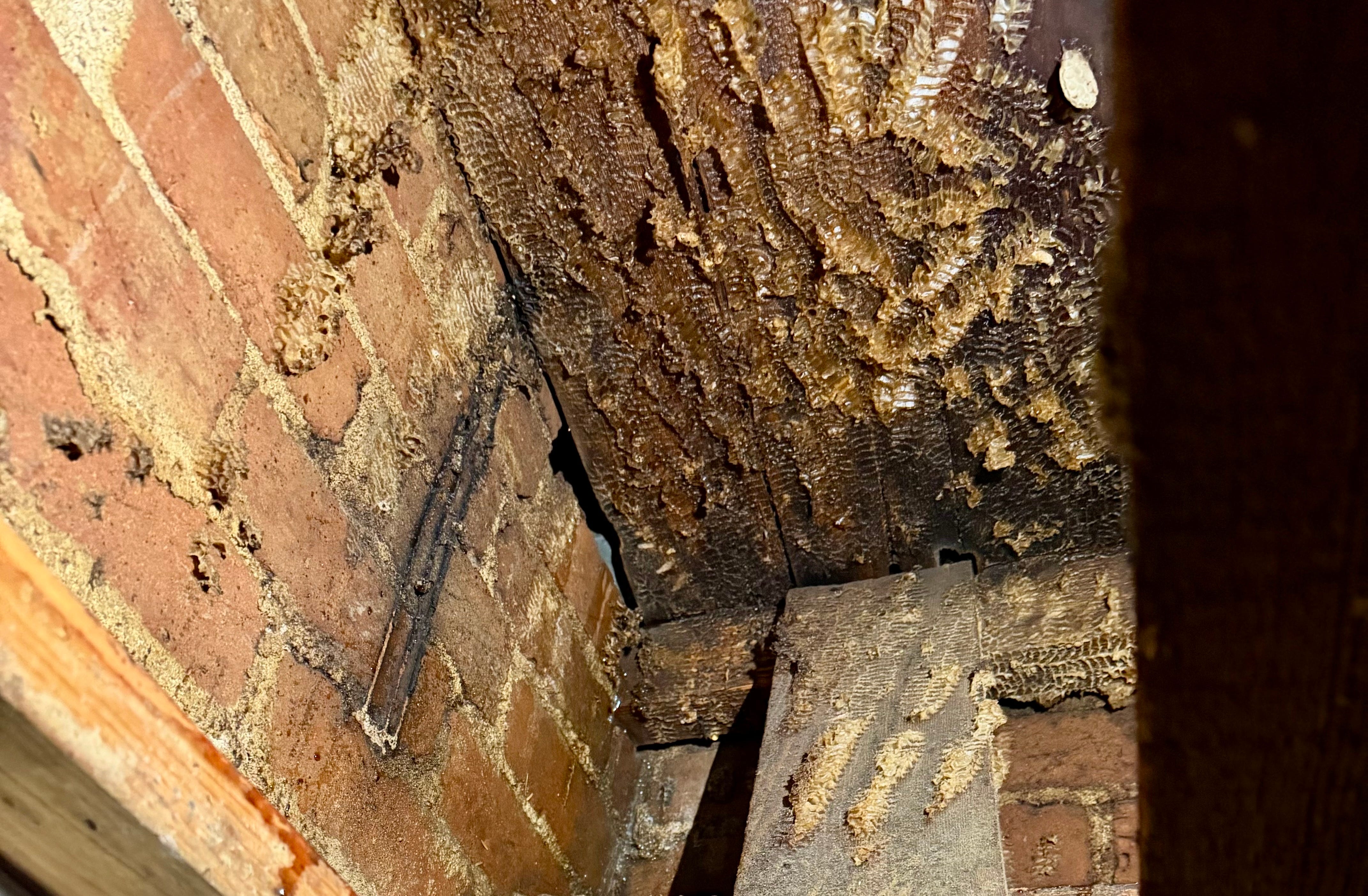
“There is nothing either good or bad, but thinking makes it so.”
-Shakespeare
Our house has been a construction zone for the last two and a half weeks. Monsoon storms came early to the Sonoran Desert this year, and although we just replaced the shingled roof on our house two years ago because of another devastating storm, the small flat portion of our roof had not been renovated. Last year we installed solar panels on that flat roof, and there didn’t seem to be any problems, so we thought everything was fine, but unbeknownst to us, our scuppers were clogged, so the water on that part of the house had nowhere else to go but through the roof into our office. Plus, because our house used to be a church, the steeply pitched main roof acted like a huge collector, dumping hundreds of gallons of water onto the flat area, creating a heavy pool that ripped the layers of roofing apart from the seams with its massive weight.
At first, the water was just coming through a single crack that spanned the office ceiling above my writing desk, dripping out mostly through the ceiling fan. Miraculously, although our antique Craftsman partner’s desk turned white with water damage and my computer got soaked, within a couple hours of setting up pots to catch the water and drying off all the surfaces, we were astonished to discover that nothing was damaged! The desk’s finish returned to its beautiful old tone of quarter-sawn fumed oak.
We called the same roofers who replaced the main portion of our roof before, and their instruments showed that the ceiling was 98 percent saturated with water, which meant it would inevitably collapse, and mold would develop. A century of plaster and paint layers was probably all that was holding everything up.
They immediately called a company that specializes in water remediation and another to box everything up and take it to a temperature-controlled storage area. Sure enough, they were able to get everything out before the ceiling came down.
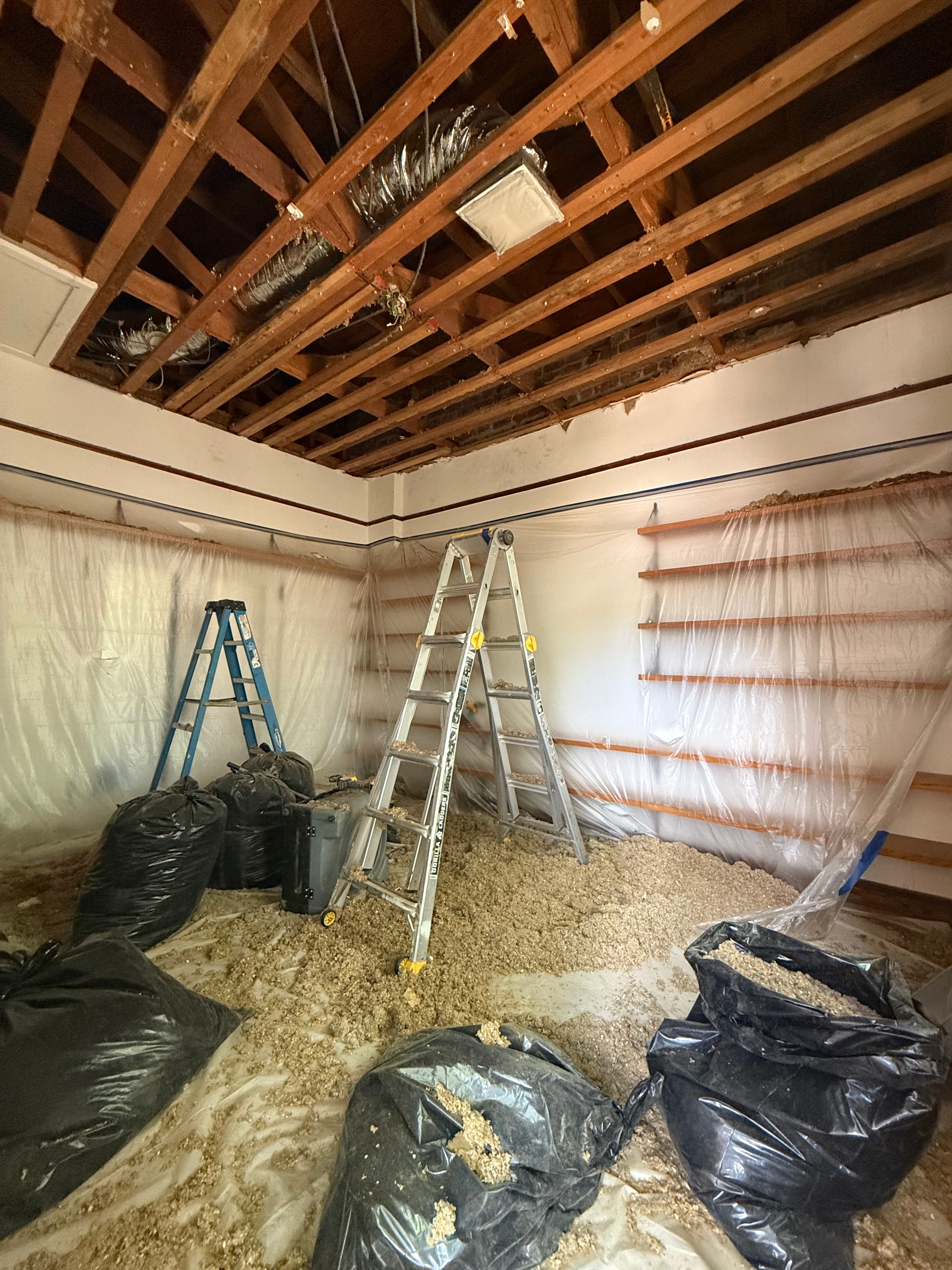
Despite the fact that much of this was not covered by insurance, amounting to about fifteen thousand dollars of out-of-pocket costs, and despite that it meant I’d lose access to my writing space for about a month, and that we would have workers at the house all day every day for the entire time, and despite the fact that I had an entire series of events I was scheduled to host, I was overwhelmed with an unexpected feeling:
Gratitude.
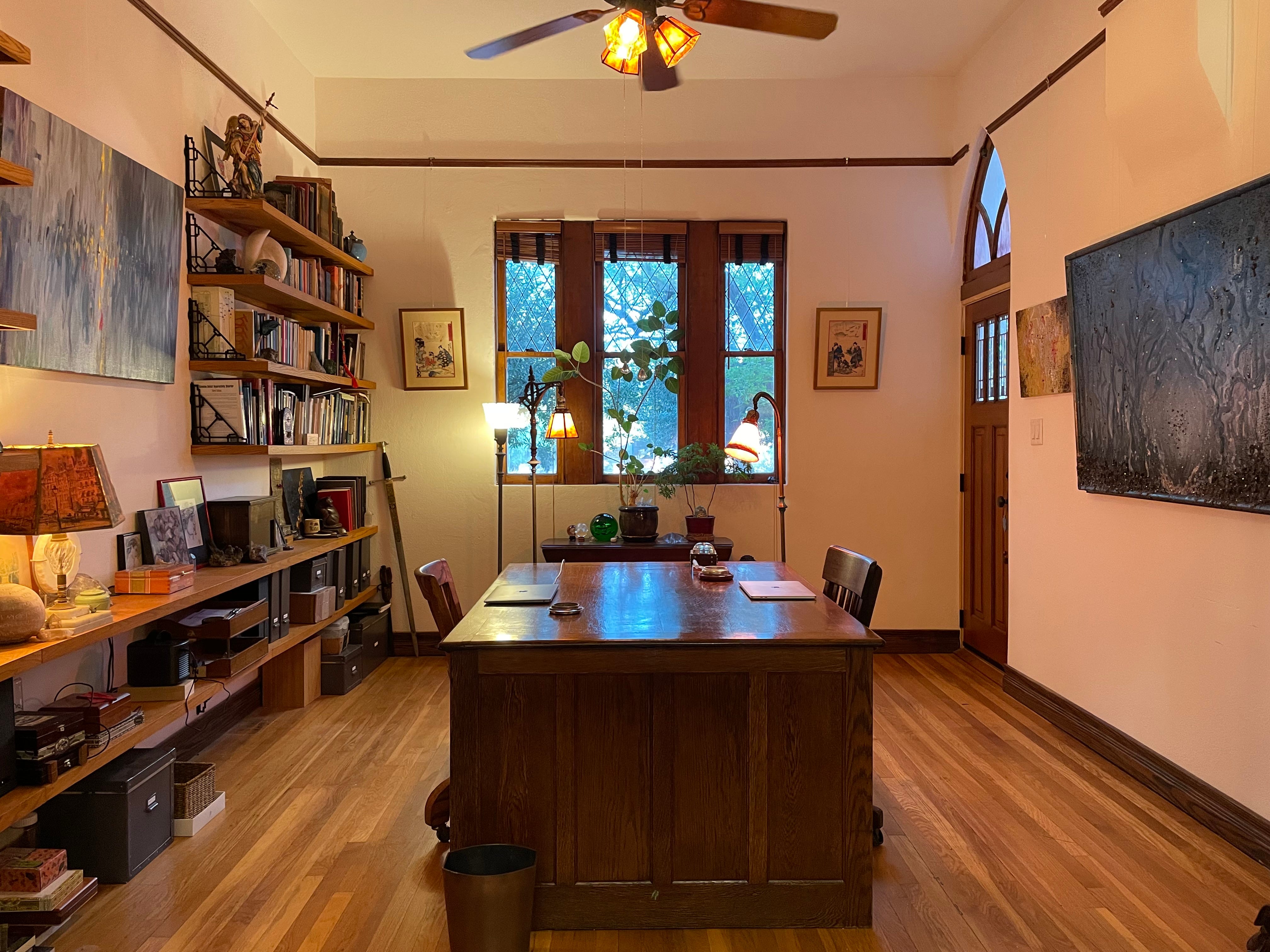
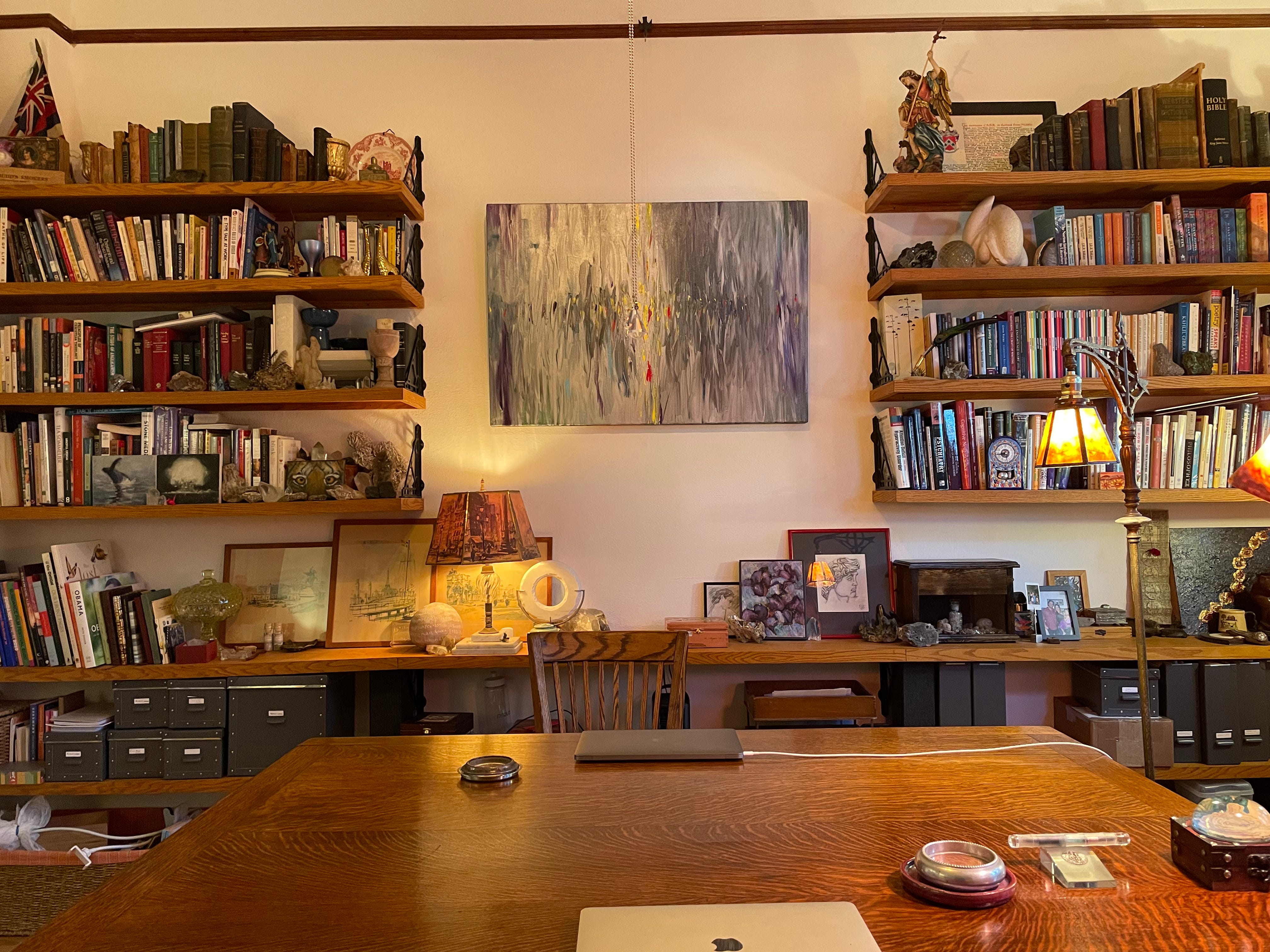
My office is my sanctuary, and all along the oak and cast-iron shelves I had hundreds of beloved books, many of them signed by the author, heirlooms, including treasured photos and my grandfather’s old paper cigar boxes, my grandmother’s high school yearbook from the 1920s, memorabilia from friends I’ve lost over the years, and an entire menagerie of irreplaceable objects. And not one was damaged. Nothing but the ceiling and money were lost. Even more, the kitchen, which opens into the office, was completely spared even though they share the same roof.
It felt like a miracle worthy of this house’s history as a place of worship.
I just kept thinking over and over again how much worse it could have been, and how, in the face of what could have been a devastating loss, we were absolutely okay.
This reminded me of something I once heard way back when I was in ministry. I was at a conference and the speaker preached about “stinking thinking.” He mentioned how an eagle has only two eyes, and it soars above the ground and can see with precision even as it takes in a wide-angle view. He then compared that with a housefly, which has thousands of lenses in its eyes so that it can see up close in ridiculous detail. He talked about how the fly, when it feeds, lands on a piece of manure and all it can see is crap, while the eagle, which feeds on prey, ignores all the crap, taking in the entirety of a landscape to sense the tiny movements on the expanse below.
“Don’t be the fly. Be the eagle!” the pastor cried, slapping his palm on the pulpit as the room erupted into rapturous shouts of Hallelujahs and Amens.

Later, when I left ministry to become a therapist, I learned about the tactic of “reframing.” In Neurolinguistic Programming, reframing is a technique used to alter one’s emotional response and behavior by shifting the perspective, or “frame,” through which one views something. By changing how we interpret a situation, we can effectively change its meaning and our resulting response to it.
If my response to the flooding of my office is any indication, apparently I’ve been practicing this so much it has become a natural instinct. The “old me” would have catastrophized this, obsessing over the damage, the expense, the hassle, the unavoidable changes I’d have to make to so many of my plans, and all the other things I’d bemoan. But somehow, that didn’t happen this time.
And I don’t think it was toxic positivity.
The day after the storm, when the ceiling was gone, my husband pointed out the remnants of an old beehive that sprawled across an entire corner of the crawlspace beneath the roof. It was beautiful, and upon watching the video he’d taken during the worst part of the flooding, we could see the water rippling over the honeycombed surface.
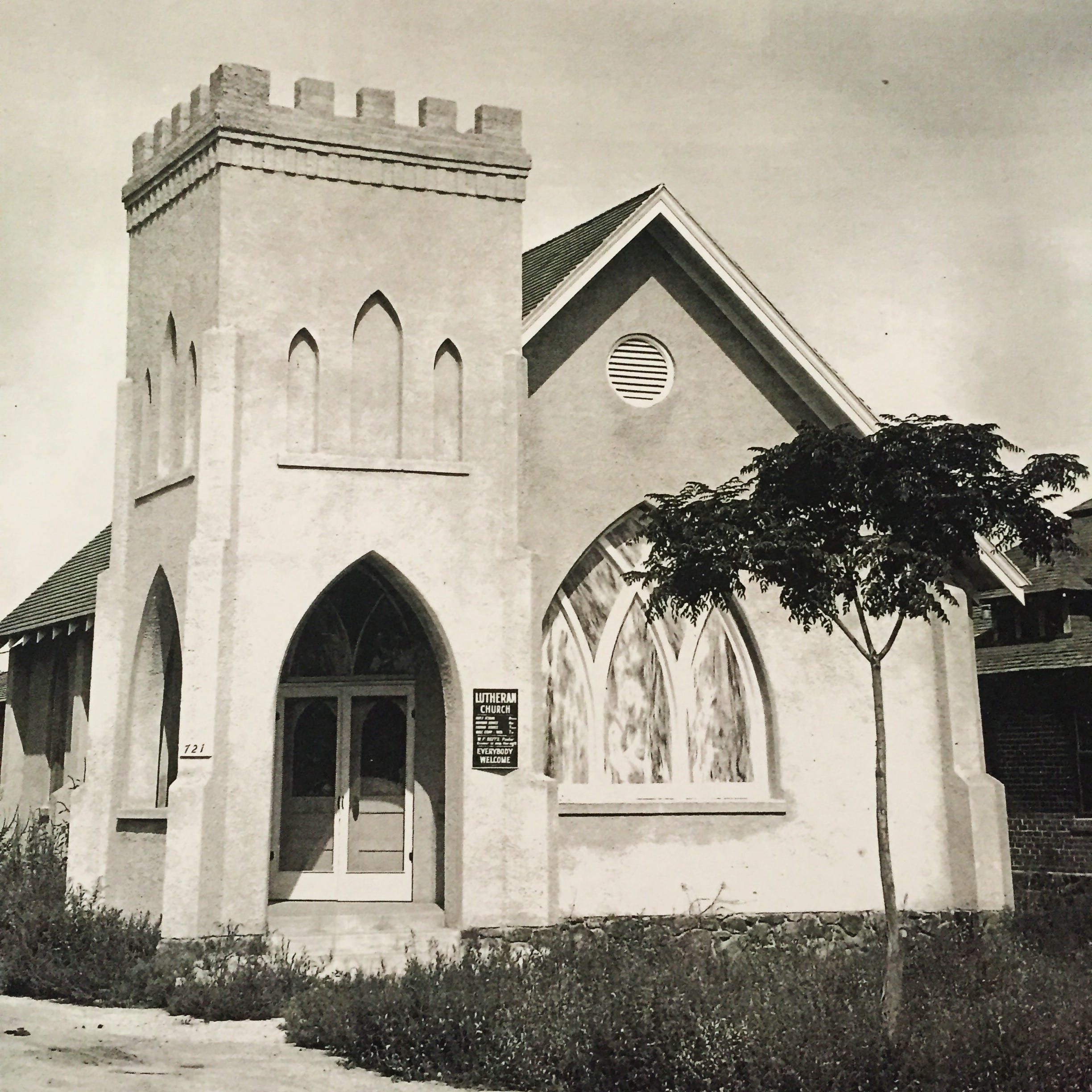
Afterward, we shone our lights up there to get a closer look and marveled at the textures and colors, appreciating this once-hidden marvel. Suddenly I felt a sense of history again, looking back over the last hundred-and-eleven years since our house was first built as Grace Lutheran Church. How many things had happened here?
When we renovated the church and turned it into a house, I’d done a tremendous amount of research, spending years at the Historical Society, the University of Arizona Special Collections Library, and even interviewing people from the current congregation of the church that left our building for a much larger one down the street in 1957.
I saw myriad floor plans that outlined the different remodels and expansions as the congregation grew, and I saw dozens of potential plans that never materialized. I learned that the congregation sold the church, only realizing in horror afterward that it’s new owner was turning it into the Altan Kol Grotto, a public meeting place for members of the Masonic Temple. In historic records, what is now my house was once referred to as “Former Lutheran Church, now a religious cult,” and the Masonic history books called it “A playground for Master Masons.”
One can imagine that the conservative Lutheran pastor who preached here, and who had lived in the attached rectory, would not have approved of such a thing!
In that research we found out that this room, which we had already converted into a makeshift bedroom for my husband’s teenage son, had been added in 1919 as the pastor’s office. We took that into consideration when we turned the building into a house, converting the room back into an office, and it quickly became one of our favorite places in the house.
It felt like a full circle moment when we completed the renovations, installing shelves, putting in a historically appropriate door, filling the space with our own holy artifacts and reliquaries, as well of several shelves filled with books about theology and spirituality. Next to prayer books and hymnals and multiple translations of the Bible, I’d arranged my collection of chalices and patens from my days administering communion in the Episcopal Church. And then there were books on indigenous spirituality, interfaith ministry, New Age manuals, astrology books I’d inherited from a dear friend who died much too young, and an entire shelf devoted to tea ceremony and other rituals. The room was not just an office. We had restored it to its place of sacred work.
Seeing the remnants of an old beehive, however, somehow gave me a wider perspective, spanning the entire century of this room’s existence, and all of a sudden it felt like my month of repairs and the thousands of dollars spent on them were almost insignificant in the grand scheme of things. They were such a small part of this house’s history, and just a hiccup in the timeline of my life.
I thought about all the struggles that had been healed in that room when parishioners came for comfort and direction. I thought of the secret rites that must have happened when this was a Masonic Grotto. I imagined the hundreds of brides, nervous or excited as they prepared in that room during the years this building was a wedding venue in the sixties, and the dancers who changed there during my home’s history as a tango studio in the seventies. My heart broke for the drug-addicted homeless people who used this as a makeshift flophouse when it became abandoned and derelict in the 1980s. I thought about the photographer who tried — and failed — to rehabilitate the building, and then I considered the hundreds of clients who received help when it then became an office for a group of therapists — the last iteration of the building before we bought it and made it home.
Suddenly, the house and its current state became a metaphor for the cycles of life, death, and resurrection, for the patterns we all have and endure and bounce back from, for the many seasons of every life that is long enough to experience them. And instead of grief or frustration, I felt connected to all of that, basking in a sense of awe at what could have been (both in terms of the forgotten stories of this property as well as how much worse this particular event could have been).
And awe was a much better place to be than grief or irritation or panic.
As someone who grew up in poverty, and who suffered enormous heartbreaks and setbacks as an adult, I am deeply aware that the ability to endure this loss with such an attitude is partly due to the many layers of privilege and access I now enjoy. But I also think of how I handled situations like this in the past, and how I would have been utterly incapacitated by something like this twenty years ago.
That makes me think that resilience is a skill that we can learn, or a muscle we can develop. This is not toxic positivity, but instead a series of choices, exercised over time, to reframe our view of the world into the eagle-eyed view encompassing the great circle of life, instead of focusing on all the crap like a housefly.
As I was pondering about all of this, a friend sent me a short video about Kenny Salwey, the last of the “river rats” living off the grid on the Mississippi River.
I was so moved by his perspective about living in harmony nature. Sure, there was all the beauty, the white-tailed deer, the bald eagle, wildflowers, and butterflies, but also the “unhuggable things,” like mosquitoes, the black mud that sucks at his boots and causes him to fall face-first into the muck, snakes, bats, poison ivy, and other things that are “necessary, as we are fellow travelers with them.”
He then clarifies:
“That’s not to say if you see a water snake sleeping on a log, you should say, ‘Oh I just love it and respect all my fellow travelers. I’m gonna give you a hug,’ because you’re gonna get you a bite in return, guaranteed. But what you can do is allow that water snake to sleep on that log. That’s called tolerance. And if we can learn to tolerate the unhuggable things in the circle of life, maybe, just maybe we’ll learn to tolerate each other a little bit better as well”
This is the wisdom that comes with seeing life through a lens of great connectedness and complexity, reframing the dangers and hassles as things (and people) that may not be huggable, safe, or lovely, but are still part of life’s great cycles.
How much of my identity is caught up in what happens to me? How many hours have I wasted obsessing over things I could not control, or things that I failed to appreciate or respect for what they were? How many times have I resented something or someone because they were thorny or poisonous or hard to deal with, when really all I had to do was keep my distance and maintain boundaries? And how many times have I had to learn my lessons from running into those painful things?
I love this view of all things in the world being our teachers, and even the dangerous things being worthy of respect and dignity even if we can only safely observe them from a distance.
This kind of perspective with my house didn’t just save me from grief and debilitating stress and anxiety either. The damage unfolded a week-and-a-half before my birthday, and I’d had marvelous plans in mind, requiring several days of cooking for a grand party. I also had plans for hosting an event for a local politician we support, and Arizona policymakers from every level, including Tucson’s mayor and city council, members of the State Legislature, and county officers were expected to be here. And yet the fully-visible office entrance is separated from the kitchen by an ugly hazmat curtain, and our yard is littered with ladders, boards, and buckets of roof coating.
Even so, we decided to go ahead with all our plans, and everyone has been supportive and understanding. In fact, I think most of them appreciate our hospitality even more because they understand what it truly took to host in a time like this. Because our kitchen was miraculously spared from the damage, despite the fact that it is adjacent to the office and shares the same roof, my husband and I were able to create an entire feast for my birthday guests.

Then, a few days later, we had a marvelous time with our political event, and the house repairs even led to meaningful discussions about climate change and water rights in Arizona, along with myriad other important connections made, policies discussed, opinions heard, and campaign funds raised — not to mention the boost we all needed at a time like this in our nation’s history. The event was more successful than we could have imagined.
At the end of the day, the history of our house is still being written, unfolding chapter by beautiful chapter, and while ceilings fall and floorboards warp, there is still community, still joy, still birthdays and parties and dinners and time spent with friends and gathering together to make a difference in our communities.
And both near and far, no matter how I frame it, that, to me, is beautiful and reason for thanks.
I love you!
Eric
Look at that bee hive! Imagine never knowing that existed. The first house my husband and I bought was an old Victorian cottage and just one week after moving in we walked into the front door and found the living room ceiling on the floor! There'd been a leak from the bathroom above. We hadn't planned on renovating at that stage but it gave us a chance to remove the horrible fake Tudor black beams that the previous owner had installed. We have bad luck with water, we've had numerous water-leak incidents. Or maybe it's just that there are no small water leaks; even small leaks lead to big problems.
The history of your home is fascinating. I wish it could tell its own story. Imagine all the tales it has! This is why we need to protect old buildings. I hate when I see historical properties knocked down to make way for boring new houses. You've played a wonderful part in that building's history, preserving it for decades to come.
Great!